


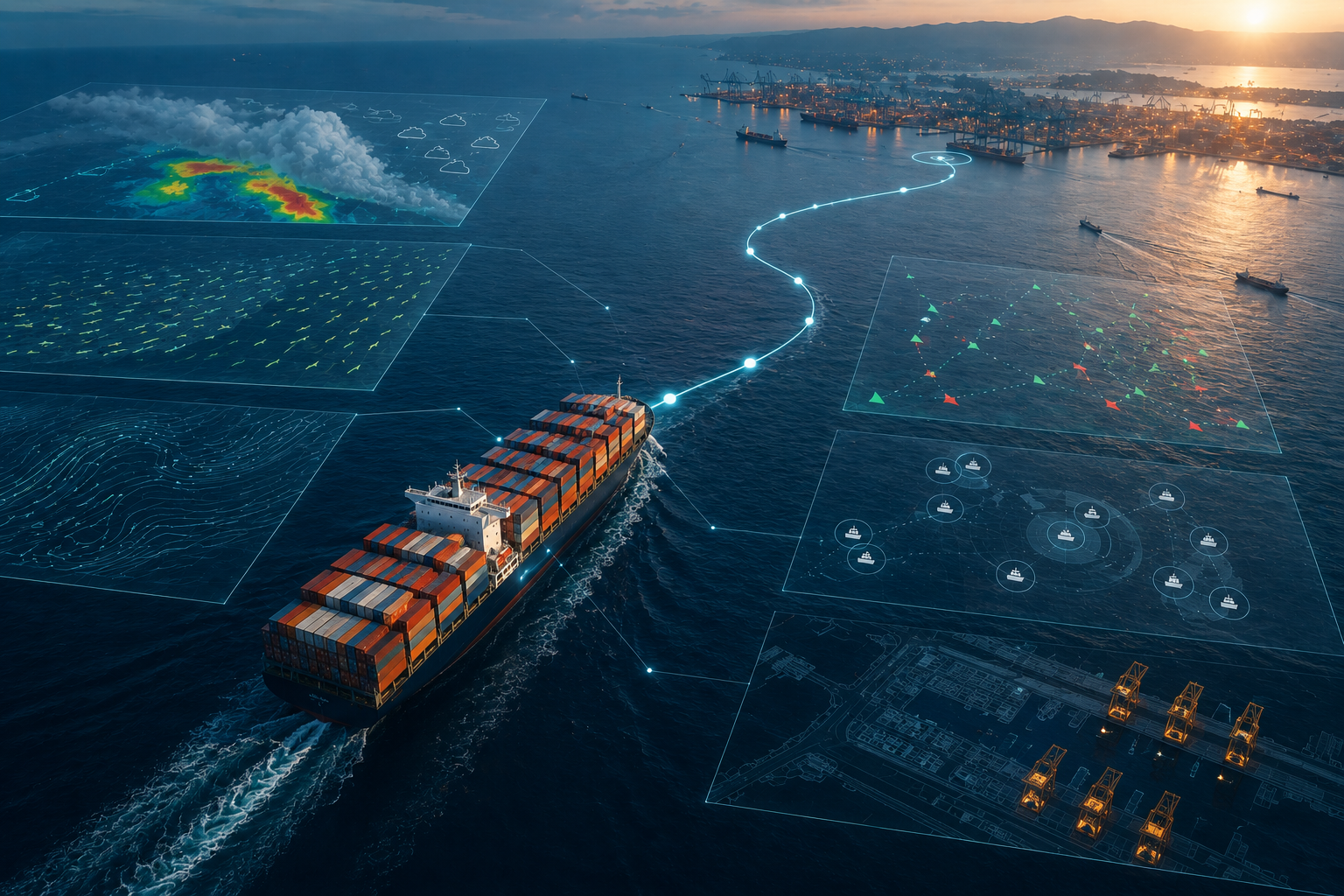
In the fast-pacedworld of global shipping, accurate ETA (Estimated Time of Arrival) predictionshave become essential for avoiding costly delays, improving coordination, andoptimizing supply chain operations. As the maritime logistics landscape grows increasinglydata-driven, traditional methods are being replaced by sophisticated machinelearning models capable of dynamically forecasting arrival times with highaccuracy.
This article opens theblack box behind modern ETA prediction systems. It explores the deep learningalgorithms that power these models, the variables that influence outcomes, andthe state-of-the-art methods that are transforming container logistics. Whetherfor port managers, logistics analysts, or data science professional, this guideprovides comprehensive insights into the technological foundation of predictiveETA systems.
How deep learning reshapes ETA prediction models in maritimelogistics
Global shipping now relies on timing as much as volume.ETA predictions have become indispensable for keeping containers flowingsmoothly, avoiding costly delays, and maintaining visibility acrossincreasingly complex and interdependent supply chains.
The logistics sector has entered a new phase where data,rather than schedules, determines accuracy. Deep learning models are nowpowering predictive systems capable of adjusting to real-world disruptions asthey unfold.
The shift from static estimation to dynamicintelligence
Historically, ETApredictions relied on basic rule-based systems and average transit durations.These approaches often fell short in complex, real-world conditions affected byport congestion, weather, or operational disruptions. With the emergence of deeplearning based systems, a new era of adaptive and resilient ETA forecasting hastaken shape.
Deep learning, asubdomain of machine learning, uses deep neural networks to model nonlinearrelationships across vast datasets. These networks ingest diverse sources ofinformation—AIS signals, port call data, vessel characteristics, and evensatellite weather maps—and refine their predictions over time throughcontinuous feedback.
Why deep neural networks are especiallysuited for ETA estimation
Deep neural networks(DNNs) excel in modeling sequential, high-dimensional, and non-linear data.Their architecture makes them particularly powerful for the maritime domain:
- They process sequences of location data and predict the remaining transit duration with increasing precision.
- They integrate structured and unstructured data from multiple sources—essential in large scale logistics operations.
- They improve continuously, adapting to new traffic patterns, regulatory changes, and emerging disruptions.
These qualities makedeep learning based ETA models significantly more effective than traditionalmachine learning algorithms in the face of real-time complexities.
A closer look at ETA prediction models: from RNNs to graphneural networks
Understanding which algorithms drive predictive accuracyreveals the technical backbone of modern ETA tools. From sequential learning tograph-based modeling, each architecture brings unique strengths to the problemof forecasting arrival times.
Deep learning architectures poweringtoday’s systems
ETA prediction systemsrely on a variety of algorithmic models. Let’s examine the most effective onesin use today:
1. Recurrent NeuralNetworks (RNNs)
RNNs are a staple oftime-series modeling, capable of capturing sequential dependencies in vesseltrajectories. They remain popular in scenarios where past vessel positionsinfluence future predictions.
2. Long Short-TermMemory Networks (LSTMs)
LSTMs address RNNlimitations by better handling long-term dependencies. They are widely used incontainer ETA predictions where delays might be rooted in earlier voyagestages.
3. Transformer-basedmodels
Originally developedfor natural language processing, transformer architectures are increasinglyapplied to logistics. Their ability to process long sequences in parallel makesthem ideal for real-time ETA updates across large networks.
4. Graph NeuralNetworks (GNNs)
Shipping routes can bemodeled as graphs, with nodes representing ports and edges denoting vesselmovements. Graph neural networks (GNNs)and graph convolutional networks (GCNs) capture the complex relationshipsbetween ports, vessel flows, and inland routes, making them suitable forpredicting ETAs across intermodal chains.
5. Ensemble and hybridmethods
Models like XGBoostand random forest are still useful in structured-data scenarios. In hybridsystems, a deep learning model might first generate features, which are thenpassed to a gradient boosting machine. In some pipelines, a random search or grid search algorithm is used tooptimize hyperparameters.
From training to performance: how ETA models are built andevaluated
Behind every high-performing model lies a carefulorchestration of data preparation, feature engineering, and trainingoptimization. Evaluating accuracy starts long before predictions are made andcontinues throughout model deployment.
Building a robust machine learning model
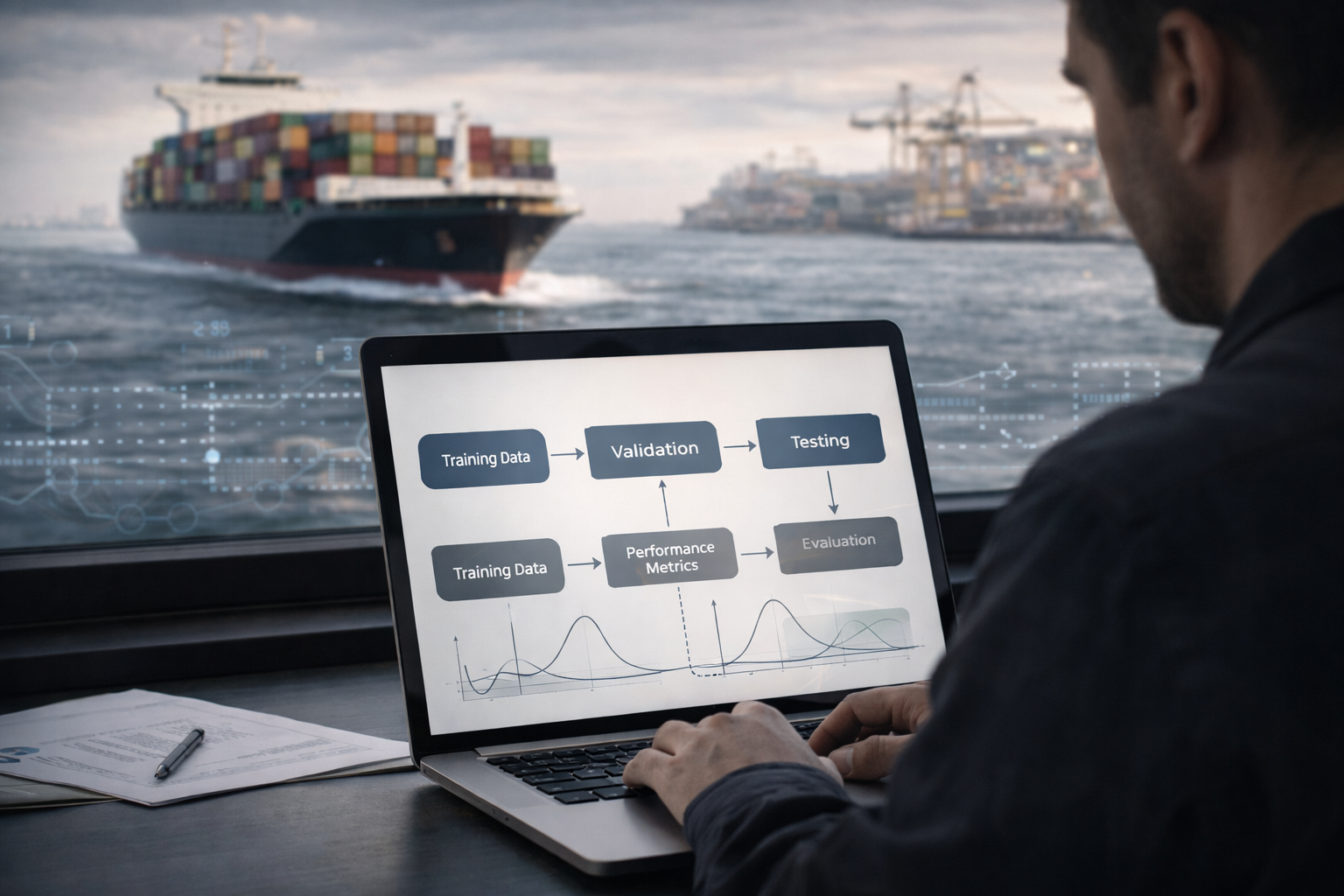
Effective modelbuilding involves converting historical and real-time data into training,validation, and testing subsets. This learningmodel training phase includes featureselection, normalization, and encoding of categorical data.
Some advancedpipelines explore multiple instancelearning, especially in cases where group-level outcomes (like batchcontainer movements) are modeled rather than individual container-levelpredictions.
Validation accuracy and hyperparametertuning
To evaluateperformance, models are benchmarked using metrics such as Root Mean SquareError (RMSE), Mean Absolute Error (MAE), and validation accuracy. Tuning methods like grid search and randomsearch are applied to optimize parameters like learning rate and batchsize. Where traditional loss gradients are unavailable, black box optimization algorithms help refine the models.
In increasinglysensitive applications, semi-supervisedlearning is being explored to make use of unlabeled or partially labeleddatasets—common in regions with incomplete AIS signal coverage.
What influences ETA predictions: decoding the variables
ETA accuracy depends not only on the model but also on thequality and relevance of the input data. Variables such as weather, congestion,and routing decisions play a critical role in determining how close predictionscome to reality.
Environmental and external disruptions
The accuracy of ETApredictions depends on external, often uncontrollable, variables. Understandingthese helps contextualize the predictions:
Weather
Weather conditions have a major impact on vessel speeds and routes.Strong winds can force ships to reduce speed, high waves increase fuelconsumption and vessel instability, and storms can lead to temporary routedeviations or complete anchorage. Even moderate conditions like fog or lowvisibility may trigger safety protocols that delay port entry. ETA models mustintegrate weather forecasts and live satellite data to adjust predictionsaccordingly and prevent underestimation of delays.
Traffic congestion
Maritime traffic, especially near busy ports and canals, functions muchlike road traffic. When too many vessels arrive in a short window, queuingbecomes inevitable. Ships may be forced to wait at anchorage for hours or evendays before gaining access to a terminal. This congestion isn't alwayspredictable far in advance, making real-time data crucial. Algorithms mustaccount for current and forecasted port traffic to maintain accurate ETAs,especially in global hubs like Singapore or Rotterdam.
Port operations
Port efficiency plays a key role in how quickly a ship can dock, unload,and depart. Delays can result from labor shortages, crane unavailability, ortechnical malfunctions in cargo-handling equipment. Even if a vessel arrives ontime, slow terminal operations can shift the effective arrival timesignificantly. Some ports also operate with tidal constraints or limited berthwindows, further complicating scheduling. ETA prediction systems need access toport operation status and berth allocation data to remain accurate..
Operational and logistics-related factors
Other influences stemfrom the operational strategies of carriers and terminals:
Vessel speed profiles
Ships do not maintain constant speed throughout their voyage. Their speeddepends on fuel optimization strategies, engine capacity, weather resistance,and maritime regulations like emissions zones. Many carriers practice"slow steaming" to reduce fuel costs and comply with CO₂ targets,which naturally extends travel time. ETA systems that only calculate based onaverage speed will miss these dynamic changes. Accurate models must ingestreal-time AIS data to track speed variation over time.
Route deviations
Shipping companies may alter routes for a variety of reasons, such asavoiding storms, geopolitical risks (like piracy zones), or rerouting aroundblocked canals or straits. Even a seemingly minor deviation can add hours ordays to a journey, especially over long distances. Static route planningsystems fail to anticipate these changes. Predictive models must includerouting logic and environmental triggers to account for route shifts and updateETAs accordingly.
Intermodal coordination
Once a container reaches port, the logistics chain doesn't stop—itcontinues by truck, train, or inland vessel. Coordination between maritime andinland modes is essential for overall delivery timing. If the predicted ETAdoesn't align with the availability of intermodal transport, containers can bedelayed at terminals, awaiting pickup. In some systems, ETA prediction is amulti-label task: forecasting arrival at the port, unloading completion, andhandover to inland carriers. Sophisticated models track not only the vessel butalso inland transportation patterns.
These factors makecontainer ETA prediction a truly multi-variable and dynamic forecastingchallenge.
Case studies: how ETA prediction algorithms work in practice
Seeing these systems in real-world action helps illustratetheir potential. Industry leaders are already deploying advanced models torefine operations, reduce delays, and better align port and inland transportstrategies.
Port of Rotterdam and LSTM integration
The Port of Rotterdamhas pioneered state-of-the-art methodsusing LSTM-based prediction models. By incorporating port sensor data, vesseltransponder signals, and real-time congestion reports, the system achieves state-of-the-art performancein berthing schedule optimization. The use of a graph convolutional network enables dynamic rescheduling based onshifting traffic flows.
Maersk’s proprietary deep learning engine
Maersk’s in-house ETAdashboard uses a combination of deepneural networks and transformer models to predict container-level andvessel-level ETAs. The system segments datainto training batches using origin, destination, vessel class, andweather forecasts, achieving higher reliability than legacy models. It alsoflags uncertainty using probabilistic confidence intervals—an emerging bestpractice in supply chain transparency.
Sinay’s environmental and ETA fusion model
Sinay applies anintegrated approach using AIS, weather, and ocean data to power its predictionengine. The platform employs graphneural architectures for understanding inter-port relations andenvironmental factors. This hybrid framework outperforms state-of-the-art statistical models by continuouslyadapting predictions based on real-time environmental feedback.
Current challenges and future advancements in ETA prediction
As ETA prediction models grow more powerful, so do thequestions surrounding transparency, fairness, and security. Ongoing research isunlocking new ways to make these tools both more explainable and more resilient
Making black box models more transparent
A major challenge inusing deep learning is their black boxnature. Without interpretability, users may distrust or misunderstandpredictions. Emerging research in explainableAI and black box optimizationoffers promising paths for generating transparent decision paths, especially inhigh-stakes logistics environments.
Toward multimodal and integratedpredictions
Future ETA systemswill combine maritime, road, and rail forecasts into a unified, learning-based prediction model.Advanced frameworks will include naturallanguage processing components to extract insights from shippingnotices, customs messages, or captain logs.
Adversarial resilience and ethical AI
As logistics growsmore dependent on AI, the risk of adversarialattacks—where malicious data alters model behavior—must be mitigated.Ensuring security in deep learning-based systems is essential for long-termdeployment and trust.
Toward a new paradigm: proposing a novelapproach
There’s an innovative approach for ETA prediction:integrating deep learning, environmental simulation, and GNN-based networkmodeling into a unified architecture. Such a system would offer predictiveaccuracy, explainability, and adaptability to disruptions—raising the bar fordigital transformation in maritime logistics.
Conclusion: unlocking the value of predictive intelligence inlogistics
ETA prediction hasevolved from a simple scheduling tool into a strategic capability, enabled by machine learning models, deep neural networks, and large-scaledata integration. With the ability to account for environmental variables, portdynamics, and intermodal factors, modern systems now offer logisticsprofessionals a competitive edge through real-time intelligence.
As graph neural networks, semi-supervised learning, and deep generative frameworks enter themainstream, the future of ETA prediction lies in flexible, secure, andtransparent architectures. The journey from opaque estimations to actionableinsights is well underway—and decoding this black box empowers betterdecisions, more resilient operations, and optimized global trade.