


The automotive industry operates on rigorous Just-in-Time (JIT) principles. However, the assembly of a single vehicle necessitates the coordination of over 30,000 individual components. According to the International Organization of Motor Vehicle Manufacturers (OICA), 60% to 70% of these inputs are sourced internationally via maritime transport.
The 2021-2022 crisis exposed the fragility of this model, resulting in a global production loss exceeding 11 million vehicles. Container delays and port congestion pose a direct threat to assembly line continuity. This case study examines how a global manufacturer secured its logistics through predictive tracking, demonstrating how the utilization of AIS data and congestion modeling transformed both inventory policy, management, and reliability.
When basic tracking is not enough: the automotive supply chain challenge
Automotive supply chains demand synchronization of extreme complexity. Supplier networks span the globe, with factories receiving daily deliveries from dozens of partners. Critical components, such as powertrains or electronics, originate in Asia with transit times ranging from 4 to 8 weeks. In this logistical ballet, even minor delays immediately disrupt precisely timed production sequences.
Conventional tracking methodologies exhibit significant limitations under these constraints. They typically provide only retrospective milestones—such as "departed" or "arrived"—lacking any predictive capability. Information remains fragmented across carrier portals and internal systems. The manual log analysis and reconciliation of this data consumes valuable time, often yielding obsolete results. Consequently, alerts generally trigger too late, only after the disruption has already impacted the schedule.
Absent advance warning, procurement departments are rendered reactive. Planners often identify shortages only when delivery trucks fail to arrive. The consequences are severe, given that a line stoppage incurs costs exceeding $20,000 per hour. The primary alternative involves expediting via air freight, at a cost premium of 10 to 15 times that of sea freight. To hedge against this, companies accumulate costly safety stocks; a 1% decrease in visibility necessitates a 5% to 8% increase in buffer inventory size.
In 2021, a European manufacturer experienced 23 production interruptions attributed to container delays. Each incident halted the line for an average of 6.2 hours, impacting 480 vehicles. Traditional tracking systems provided alerts only 12 to 18 hours prior to delivery, rendering effective reaction impossible. The financial impact exceeded €18 million. With only 2 to 3 days of available inventory, the facility could not absorb these latencies. The transition from a reactive model to predictive intelligence became a matter of operational survival.
Moving to predictive container tracking: project setup and data foundations
Executive leadership initiated a transformation in information accessibility to enhance On-Time In-Full (OTIF) delivery performance.
The objectives were explicit: mitigate stockouts, minimize the size of safety stock requirements, and eliminate reliance on emergency air freight. Conventional carrier negotiations had proven insufficient. Consequently, the solution necessitated illuminating the logistical "black box" spanning the interval from supplier loading to port arrival. This required a robust data policy to ensure consistency.
This novel approach aggregates diverse information streams. The system integrates real-time AIS vessel tracking, carrier schedules, and historical port congestion data. Furthermore, it incorporates meteorological metrics and seasonal demand spikes, such as Golden Week. This composite dataset enables a level of granular analysis unattainable through single-source monitoring.
The architecture directly interfaces maritime data platforms with the manufacturer's Transport Management System (TMS). Cross-referencing with the Enterprise Resource Planning (ERP) system facilitates the automated identification of critical components. Planners receive targeted alerts, while executive leadership monitors overall efficiency via role-specific dashboards.
Deployment commenced with a pilot program focusing on two critical Asian suppliers, representing 15% of total volume but 40% of the risk profile. Following a three-month interval, arrival forecast accuracy improved by 85% relative to carrier-supplied data. Building on this success, the program was scaled enterprise-wide. Team training emphasized proactive decision-making leveraged by this enhanced visibility and situational awareness.
From tracking to prediction: how the new system works in practice
The operational logic represents a radical change and paradigm shift from traditional milestone-based tracking.
The system isolates the specific vessel transporting each critical container. AIS monitoring updates positional data at 5-to-15-minute intervals. Unlike static carrier estimates, which frequently exhibit discrepancies of 12 to 48 hours, the system continuously recalculates the Estimated Time of Arrival (ETA). It integrates actual speed over ground, meteorological conditions, and known port congestion data.
Artificial Intelligence refines these forecasts. Algorithms analyze thousands of historical voyages to derive actual transit times and refine every prediction. They integrate seasonal variables such as monsoon cycles or North Atlantic winter conditions. Furthermore, the models estimate port-specific dwell times and the historical reliability of individual vessels.
Teams receive automated alerts immediately upon detection of a schedule deviation. A notification issued five to seven days prior to the deadline allows for orderly production rescheduling. Shorter-notice alerts trigger targeted emergency protocols. Prioritization logic ensures that teams focus exclusively on critical at-risk components, creating a digital log of every potential issue.
During the 2023 typhoon season, the system identified a threat affecting three vessels carrying electronic components. It projected a delay of 4 to 6 days. Alerted 72 hours in advance, the manufacturer adjusted its production mix and expedited select parts via air freight. This operational agility incurred €340,000 in logistics costs, effectively averting a production stoppage estimated at €2.8 million.
The supply chain has acquired adaptive capabilities. In the event of unavoidable delays, production planners adjust assembly sequences, while procurement teams expedite replacement manufacturing and logistics personnel identify alternative routing. Thanks to predictive foresight and greater awareness, this coordination is now executed over a timeframe of days rather than hours.
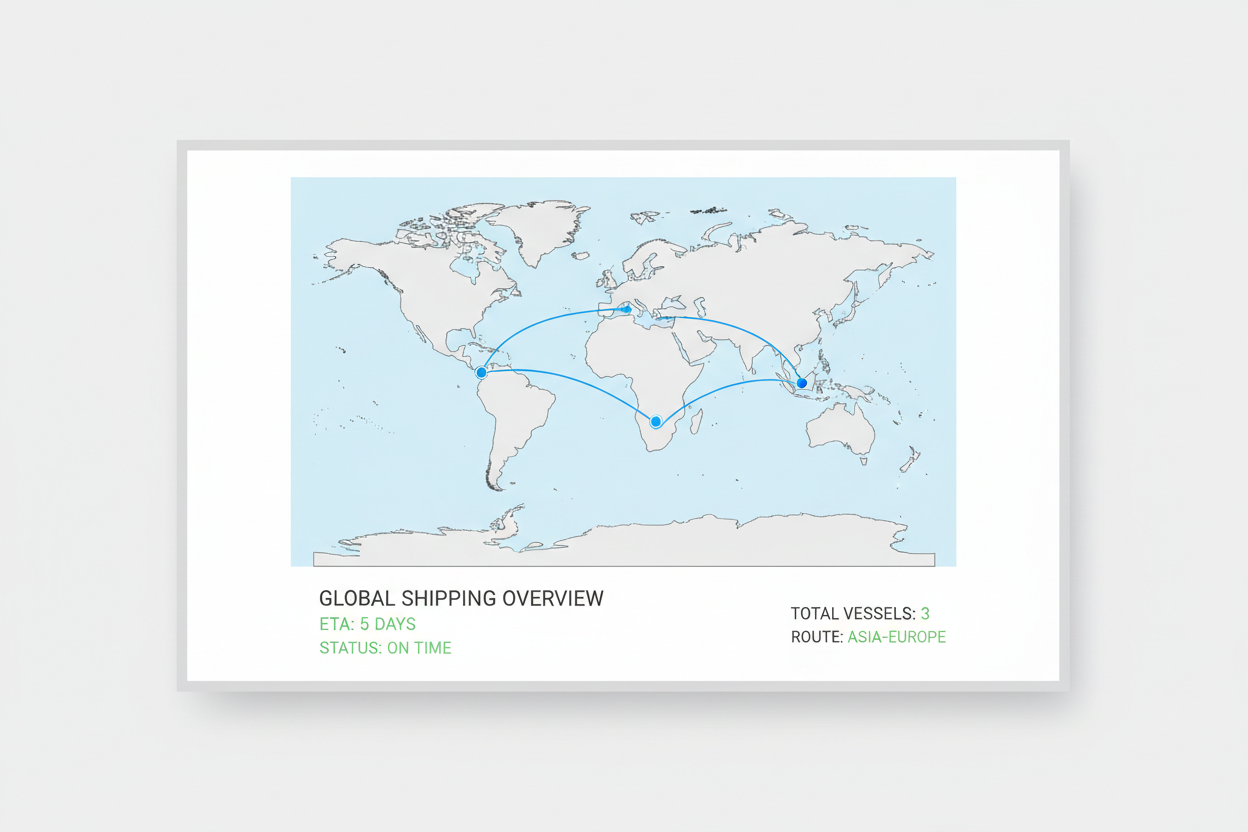
Measurable impacts: reducing delays, costs, and production risks
Quantitative results validate the efficacy of this strategy. OTIF performance surged from 73% to 91% over a twelve-month period. This 18-percentage-point increase encompasses tens of thousands of containers. Such enhanced reliability facilitated a systematic reduction in safety stock levels.
Assembly line stoppages declined dramatically. Incident frequency dropped from 2.1 events per month to merely 0.3, representing an 86% decrease. Residual anomalies were no longer attributable to maritime transport. This operational continuity preserved an estimated €22 million in annual value.
Enhanced visibility drove down emergency expenditures. Air freight costs decreased by 67%, falling from €8.4 million to €2.8 million annually. Predictive capability enables the selection of cost-effective alternatives, restricting air transport to a measure of last resort.
Safety stock was reduced without elevating the risk profile. For targeted components, inventory coverage decreased from 8.2 to 5.1 days, a 38% reduction. This optimization released €31 million in working capital and conserved warehouse capacity.
Confidence has been restored within supply chain management. Forecasting is reliable, and carrier negotiations are now grounded in objective data. Furthermore, transparency toward clients has improved, thereby reinforcing the manufacturer's credibility.
Sinay as a strategic data partner for predictive maritime logistics
We consolidate and analyze maritime data to provide comprehensive visibility into logistical flows.
Our methodology integrates diverse information streams to support decision-making. By synthesizing vessel movements, port operations, and meteorological data, we transform the supply chain into a strategic asset. This strategic change will prove vital for long-term resilience.
Our algorithms calculate realistic Estimated Times of Arrival (ETAs) in real time. We quantify port congestion to preclude overly optimistic assumptions. Continuous monitoring eliminates "blind spots" during ocean transit. These tools are accessible via web dashboards, mobile applications, and APIs interfacing directly with enterprise systems.
The case of this manufacturer demonstrates the efficacy of our solutions. Seamless integration with their TMS and ERP systems facilitated rapid adoption. The transformation from milestone-based tracking to continuous intelligence directly generated the documented performance gains and cost savings.
This value proposition applies to any industry sensitive to maritime delays. Pharmaceuticals, high-tech, and consumer electronics face identical challenges. Our solutions transform the maritime transport "black box" into controlled operations, quantifiably mitigating risk.
Data-driven logistics is becoming a major competitive advantage. Equipped enterprises maintain lower inventory levels and react more rapidly to contingencies. We continue to advance our platform to deliver increasing precision and intelligence.
Conclusion
The transition to predictive tracking transforms maritime uncertainty into manageable variables. The manufacturer’s experience demonstrates this: an 18-point gain in OTIF, an 86% reduction in disruptions, a 67% decrease in emergency costs, and a 38% optimization of safety stock. These figures validate the power of the predictive approach, the strategic intelligence that all Industries operating with tight margins must adopt. Through specialized partnerships, they will achieve superior reliability and differentiate themselves from the competition.