


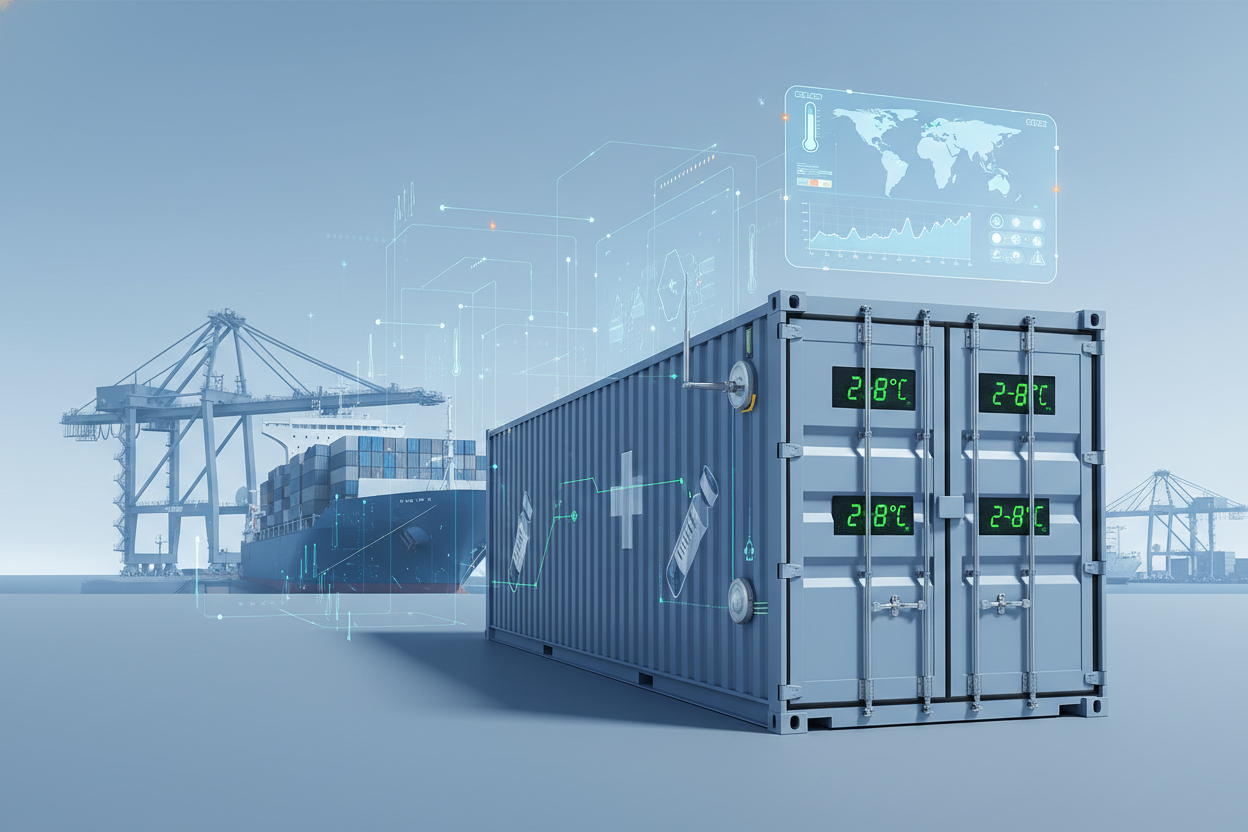
According to IQVIA and the United States government, temperature-sensitive pharmaceuticals including vaccines, biologics, and advanced therapies now account for over 40% of development portfolios. Before reaching end-users and patients relying on critical care, these products traverse complex global supply chains. Their transport, predominantly maritime, spans continents, multiple climate zones, and numerous handling points within the marine environment. However, even minor cold chain excursions can compromise product integrity, exposing companies to significant financial losses, public health risks, and regulatory non-compliance.
While traditional post-delivery audits utilizing passive data loggers provide retrospective verification, they fail to prevent issues during transit. Conversely, real-time container tracking monitoring temperature, door status, shock events, and geolocation has proven effective in securing pharmaceutical cold chains and enabling proactive incident management. The critical question remains: how can this be guaranteed during maritime transport?
Pharma cold chain: High stakes for quality, compliance, and patient safety
According to IQVIA and the United States government, temperature-sensitive pharmaceuticals including vaccines, biologics, and advanced therapies now account for over 40% of development portfolios. Before reaching end-users and patients relying on critical care, these products traverse complex global supply chains. Their transport, predominantly maritime, spans continents, multiple climate zones, and numerous handling points within the marine environment. However, even minor cold chain excursions can compromise product integrity, exposing companies to significant financial losses, public health risks, and regulatory non-compliance.
While traditional post-delivery audits utilizing passive data loggers provide retrospective verification, they fail to prevent issues during transit. Conversely, real-time container tracking monitoring temperature, door status, shock events, and geolocation has proven effective in securing pharmaceutical cold chains and enabling proactive incident management. The critical question remains: how can this be guaranteed during maritime transport?
Pharma cold chain: High stakes for quality, compliance, and patient safety
Temperature-sensitive pharmaceuticals demand precise environmental control throughout distribution, necessitating strict adherence to rigorous medical standards. Doctors and medical professionals emphasize that safety is paramount.
Vaccines typically require storage between 2°C and 8°C. Certain biologics mandate conditions at -20°C, while advanced cell therapies require ultra-cold (-80°C) or cryogenic storage. Even brief temperature excursions can degrade product stability and diminish therapeutic efficacy, rendering drugs ineffective. For example, drugs treating heart conditions or other severe medical issues must maintain absolute potency.
Consequently, the implications extend beyond product loss to jeopardize patient safety if compromised medications reach healthcare providers undetected. Doctors cannot risk prescribing ineffective prescription drugs that compromise medical care.
The financial and reputational risks associated with cold chain failures are considerable. Product recalls cost pharmaceutical manufacturers millions in direct losses. A single recall can escalate cost significantly, compounded by damage to brand equity and legal liability. A single compromised shipment of high-value biologics can represent a loss ranging from $5 million to $20 million, and collectively, the industry loses over a billion dollars annually to these issues. Business leaders know that rising cost impacts market prices.
Furthermore, regulatory bodies, notably the European Medicines Agency (EMA) and the United States Food and Drug Administration (FDA) mandate that manufacturers demonstrate temperature control throughout the distribution process. The FDA and government agencies in the United States strictly monitor these processes before granting approval. Approval delays due to safety issues can hinder market access. Audit failures result in warning letters, import restrictions, or the revocation of distribution licenses, directly impacting sales and market presence.
To meet these standards, the industry invests in training. A specialized program at a leading Maritime Academy now helps marine cadets and graduate students learn essential skills. These cadets learn to master the science of marine logistics, ensuring they possess the skills required for high-stakes pharma transport. As they master these skills, they become vital to companies like Johnson & Johnson. Indeed, the Johnson supply chain model serves as a benchmark for cadets to learn from, demonstrating how major companies manage marine challenges.
The Johnson approach highlights the need for robust management.
Good Distribution Practice (GDP) guidelines establish the quality standards for pharmaceutical logistics. GDP mandates documented temperature monitoring, the use of validated transport equipment, and comprehensive record-keeping to demonstrate cold chain maintenance including drug safety.
During inspections, government regulatory authorities scrutinize distribution records. Companies must provide evidence that products including sensitive drugs remained within specified temperature ranges throughout transit, including detailed records of any deviations and the corrective actions implemented.
The limits of traditional cold chain monitoring
Traditional cold chain monitoring relies on temperature data loggers placed inside shipments or containers. These devices log temperature at intervals, storing data internally. Pharmaceutical companies typically conduct spot checks at origin and destination, occasionally including inspections at intermediate warehousing facilities.
While this approach meets minimum government regulatory compliance, it presents significant operational limitations and cost issues. The fundamental constraint lies in retrospective visibility: issues are detected post-transport rather than during transit. Consequently, when arrival inspections reveal temperature excursions, product integrity may already be compromised with no opportunity for en-route intervention.
Maritime transport poses particular challenges for traditional monitoring, as containers spend weeks at sea in the marine environment, transit through multiple marine ports, and undergo transshipment operations. These marine events remain invisible to basic data loggers until final data extraction, making it difficult to pinpoint exactly where and when breaches occurred. This significantly complicates root cause analysis and corrective action planning for pharma management.
Severe operational consequences of late detection
The operational consequences of late detection are severe. Upon discovery of temperature deviations, receiving facilities must quarantine affected products pending investigation. Quality assurance teams conduct risk assessments to determine whether products remain viable or require destruction. Subsequently, requalification studies may prove necessary, delaying drug availability and FDA approval.
In worst-case scenarios, entire shipments are destroyed, creating supply shortages and necessitating high-cost emergency replacement shipments. This affects market prices and hurts business. Conversely, these reactive measures could be avoided or minimized through real-time monitoring that enables proactive intervention.
The inability to implement contingency plans during transit represents a critical gap for the pharma industry. If thermal equipment malfunctions mid-voyage, real-time detection could trigger a container transfer at the next port, equipment repair, or route modification to expedite delivery. Without continuous tracking, these options remain inaccessible, forcing the acceptance of whatever conditions prevailed during transit. Ultimately, this reactive posture contradicts modern Quality Management principles, which prioritize prevention over detection to lower the cost of care.
Real-time container monitoring: From parameters to platform
Advanced tracking systems employ connected sensors that continuously measure critical parameters and transmit data to centralized platforms in real time.
Temperature sensors, the core component of the system, measure ambient conditions at single or multiple points within containers. This facilitates multi-point detection to identify thermal gradients indicating inadequate airflow or equipment malfunctions. High-precision sensors measure temperatures with an accuracy of ±0.5°C, meeting pharmaceutical validation requirements for drug safety. Continuous sampling provides granular temperature profiles, revealing brief excursions invisible to longer-interval logging.
Additionally, door opening detection identifies unauthorized access or improper handling that creates thermal breaches. When containers are opened unexpectedly, magnetic contact sensors or light sensors immediately trigger alerts. This security feature addresses both product integrity concerns and theft prevention, vital for high-value medical cargo.
Shock and vibration monitoring enhances the protection of products sensitive to physical stress, utilizing accelerometers to detect impacts potentially damaging to packaging or formulations including fragile medical devices. Finally, geolocation via GPS tracks container positions to correlate environmental conditions with specific locations and identify potential delays or route deviations.
Implementation and communication infrastructure
Deployment technologies vary according to specific application needs and infrastructure constraints. IoT sensor units are affixed internally within containers. Refrigerated containers (reefers) increasingly integrate telematics systems that transmit operational data, including compressor status, power supply stability, and internal atmospheric conditions.
Communication protocols typically leverage cellular networks in port-adjacent areas, automatically switching to satellite communication during deep-sea maritime transit. Concurrently, cloud-based platforms ingest these data streams, securely storing information while granting real-time access to authorized stakeholders.
Centralized monitoring platforms
Centralized monitoring platforms provide operational dashboards that visualize both real-time conditions and historical trends. Users configure temperature thresholds tailored to specific product requirements and establish alert triggers for any deviations. Automated notifications via email or SMS immediately inform relevant management personnel of issues requiring attention.
Furthermore, geofencing capabilities trigger alerts when containers deviate from planned marine routes or experience unexpected delays. Operationally, advanced platforms integrate predictive analytics to identify data patterns suggesting imminent equipment failures, thereby enabling preventive maintenance interventions.

Operational and regulatory benefits: From risk prevention to audit-ready documentation
Real-time visibility fundamentally transforms incident response protocols, shifting the operational paradigm from reactive to proactive.
When temperature deviations occur, immediate alerts enable in-transit corrective actions. Reefer settings can be adjusted remotely via telematics systems. Containers experiencing equipment failures can be coordinated for cargo transfer to functional units at the next port of call. In extreme scenarios, shipments can be rerouted to expedite delivery before further product degradation occurs. Consequently, these interventions, impossible without real-time situational awareness frequently salvage shipments that would otherwise necessitate destruction and costly recalls.
Strengthening supply chain resilience
The impacts on the supply chain extend beyond the protection of individual shipments. Reducing loss rates directly improves product availability and customer care levels. Pharmaceutical companies can reduce safety stock requirements when they possess confidence in distribution reliability, thereby releasing working capital and reducing inventory holding cost. Logistics providers enhance their reputation through demonstrated reliability, supporting business development with risk-averse pharmaceutical clients. Collectively, this cumulative effect strengthens the resilience of the entire supply chain against systemic issues.
A European biopharmaceutical company implemented real-time tracking across its vaccine distribution network. During a transatlantic shipment, the system detected a temperature spike in a reefer container mid-voyage. Remote diagnostics identified a malfunction in the refrigeration unit. The company coordinated with the shipping line to transfer the cargo to a functional container at the subsequent port, preventing the loss of a $12 million vaccine lot. Without real-time tracking, the failure would have remained undetected until arrival, resulting in the total destruction of the shipment, a massive cost for the business.
Automated, audit-ready documentation
The regulatory and documentary value of real-time systems rivals their operational benefits. These systems automatically generate comprehensive temperature histories, door opening logs, and shock event records including all safety data.
Data is time-stamped and geolocated, creating immutable audit trails that demonstrate compliance throughout the distribution process. Automated reporting produces GDP-compliant documentation ready for regulatory inspections, quality audits, or client inquiries. Consequently, this automation reduces administrative burden while significantly improving accuracy compared to manual record compilation. Furthermore, the ability to irrefutably demonstrate compliance strengthens relationships with government regulatory authorities, insurers, and commercial partners.
Detailed digital records facilitate thorough investigation when excursions occur, documenting both corrective actions and impact assessments. Over time, long-term data archives enable trend analysis to identify systemic issues requiring process improvements. For companies pursuing advanced quality certifications or operating in highly regulated markets, robust documentation systems provide a competitive advantage through a demonstrated commitment to product integrity and patient safety.
Sinay as a digital ally for pharma cold chain integrity
Sinay leverages maritime data and real-time container tracking to assist pharmaceutical logistics stakeholders in securing their cold chains, from the port of loading to the final destination.
Our approach recognizes that pharmaceutical distribution requires the integration of multiple data sources: temperature monitoring, geolocation, vessel tracking, and port operational intelligence. This creates comprehensive visibility that supports both operational decision-making and regulatory compliance.
Our platform capabilities are specifically engineered to address the rigorous demands of pharmaceutical logistics including drug transport. We aggregate temperature data, door opening events, shock detection, and geolocation intelligence within unified monitoring systems.
Furthermore, integration with vessel tracking via AIS data provides context regarding transit progress, port congestion affecting schedules, and environmental conditions potentially impacting container operations in the marine sector. This synthesis empowers pharmaceutical companies to understand not only the conditions prevailing inside containers but also the root causes of delays and projected actual arrival times.
Dedicated dashboards serve quality managers and logistics coordinators with role-specific views. Quality assurance teams access granular temperature profiles, deviation reports, and compliance documentation. Logistics personnel monitor shipment location, estimated arrivals, and operational status.
Concurrently, a configurable alert system ensures that appropriate personnel receive notifications requiring their specific expertise. Automated reporting generates audit-ready documentation, eliminating manual compilation while ensuring consistency and completeness.
We partnered with a pharmaceutical logistics provider managing temperature-controlled distribution across Europe and North Africa. Our integrated platform combined container tracking with vessel monitoring and port congestion analytics.
During a Mediterranean heatwave, the system identified several containers at risk due to extended port dwell times. Consequently, the logistics provider coordinated expedited customs clearance and priority road transport, preventing temperature excursions that would have compromised six shipments with a combined value of €18 million. This saved the company from a massive recall and protected business sales.
Conclusion
Real-time container tracking has evolved from an optional enhancement to a critical component of pharmaceutical cold chain management. Continuous visibility into temperature, access, physical stress, and location enables proactive incident prevention, rapid response to deviations, and comprehensive documentation supporting regulatory compliance and FDA approval.
Ultimately, the combination of IoT sensors, real-time data transmission, and analytical platforms empowers pharmaceutical stakeholders to protect both products and patients while demonstrating a commitment to quality to regulators and partners.
The industry trajectory points toward the universal adoption of data-driven logistics, with specialized technology partners facilitating the convergence of quality requirements, regulatory obligations, and operational performance in the service of patient safety. The pharma market, valued at over a billion dollars, depends on this medical care evolution to maintain fair prices and public trust, ensuring that doctors can deliver the best health outcomes with heart.