
CO2 Emissions Revolutionize Your Maritime Emissions Monitoring
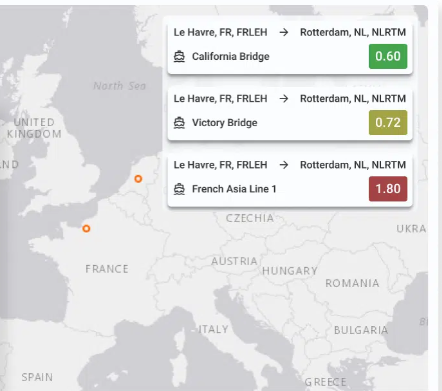
Accurately monitor and estimate carbon emissions for any sea voyage per TEU. Plan ahead or calculate post-voyage emissions with precision and ease.
{
"routes": [
{
"departure_port": {
"name": "Le Havre",
"country": "FR",
"unlo_code": "FRLEH"
},
"arrival_port": {
"name": "Rotterdam",
"country": "NL",
"unlo_code": "NLRTM"
},
"vessel": {
"routes": [
{
"departure_port": {
"name": "Le Havre",
"country": "FR",
"unlo_code": "FRLEH"
},
"arrival_port": {
"name": "Rotterdam",
"country": "NL",
"unlo_code": "NLRTM"
},
"vessel": {
.webp)
Monitor and Reduce Environmental Impact in Maritime Transport
Maritime transport plays a vital role in global commerce but also has a significant environmental impact. Using our API, you can obtain valuable information about your vessels' environmental impact and take proactive measures to reduce carbon emissions and noise pollution. This will not only help protect the environment but can also improve your vessel's efficiency and reduce costs.
Integrated APIs:
Vessel API
Ports and Vessels API
ETA API
Why Choose Sinay's CO2 API?
Global Coverage
Monitor emissions for any route worldwide
Real-time Calculations
Get instant CO2 estimates for your voyages
Historical & Future Estimates
Plan ahead or analyze past journeys
Accurate Reporting
Comply with international regulations easily
Vessel-specific Data
Tailored calculations for your fleet
Eco-friendly Decision Making
Optimize routes for lower emissions
How It Works
Input vessel and journey details
Our AI processes the data using advanced algorithms
Receive accurate CO2 emission estimates
Use the data for reporting, optimization, and decision-making
Calculation Methods
1. Sinay Methodology:
Using Holtrop & Mennen Approximate Power Prediction modelization
2. GLEC Framework:
Trade lanes method presented by the Smart Freight Center

Smart Freight Center Accredited
SINAY is accredited by Smart Freight Centre to provide carrier greenhouse gas emissions data for freight and logistics operations that are in methodological conformance with the Global Logistics Emissions Council Framework for Logistics Emissions Methodologies (GLEC Framework) ©
APIs
Easy Integration
Integrate in Minutes
Our RESTful API is designed for quick and easy integration into your existing systems. Follow these simple steps:
- Comprehensive Documentation
- Webhook Security
- Error Handling
Input Parameters
Sample API Request
Vessel Identification (IMO or MMSI)
Port of Departure (UNLO code)
Port of Arrival (UNLO code)
Speed (optional, in knots)
Vessel Identification (IMO or MMSI)
Port of Departure (UNLO code)
Port of Arrival (UNLO code)
Speed (optional, in knots)
Output Data
CO2 emissions data provided
Tons of CO2 equivalent per TEU (TTW, WTT, WTW)
Results for both Sinay and GLEC Framework methods
Tons of CO2 equivalent per TEU (TTW, WTT, WTW)
Results for both Sinay and GLEC Framework methods
How does the CO2 Emissions API calculate emissions?
Two methods. Vessel modelling estimates fuel consumption from the ship's physical characteristics such as hull, engine and capacity, and covers Tank to Wheel only. The tradelane method applies GLEC Framework 2019 emission factors and covers Well to Tank, Tank to Wheel and Well to Wheel.
What does the response contain?
The voyage length in nautical miles and an estimate of the tons of CO2 emitted per TEU, given by each method.
What inputs are required?
A vessel IMO or MMSI, but not both in the same request, plus a departure port and an arrival port identified by their 5-character UN/LOCODE.
Can I set the vessel speed?
Yes, optionally, in knots, capped at 25. Without it, the average speed is computed by SafeCube's routing system.
Ready to Revolutionize Your CO2 Emissions Monitoring?
Join the growing number of companies using Sinay's CO2 API to track, optimize, and report their maritime emissions with unprecedented accuracy.
No credit card required • 14-day free trial • Setup in 5 minutes